slider_dienstleistungen_01.png
We are experts in ground reinforcement
using resin injections.
We are experts in ground reinforcement
using resin injections.

On-site consultation

The aim of the on-site consultation is to thoroughly assess the damage, take into account all important information – such as your own observations, existing plans, water-bearing utility lines, any building site investigations or public geodata – diagnose the cause of the damage and propose specific measures to repair it.

If a building ground PUR injection is the best and most economical solution, we will be happy to provide you with a competitive quote.

We are pleased to offer this service free of charge throughout Switzerland.

Take advantage of our expertise and make an appointment today.

Stopping building subsidence

The most cost-effective and quickest solution for stopping building subsidence is to reinforce the unstable ground beneath the foundations using PUR injections.

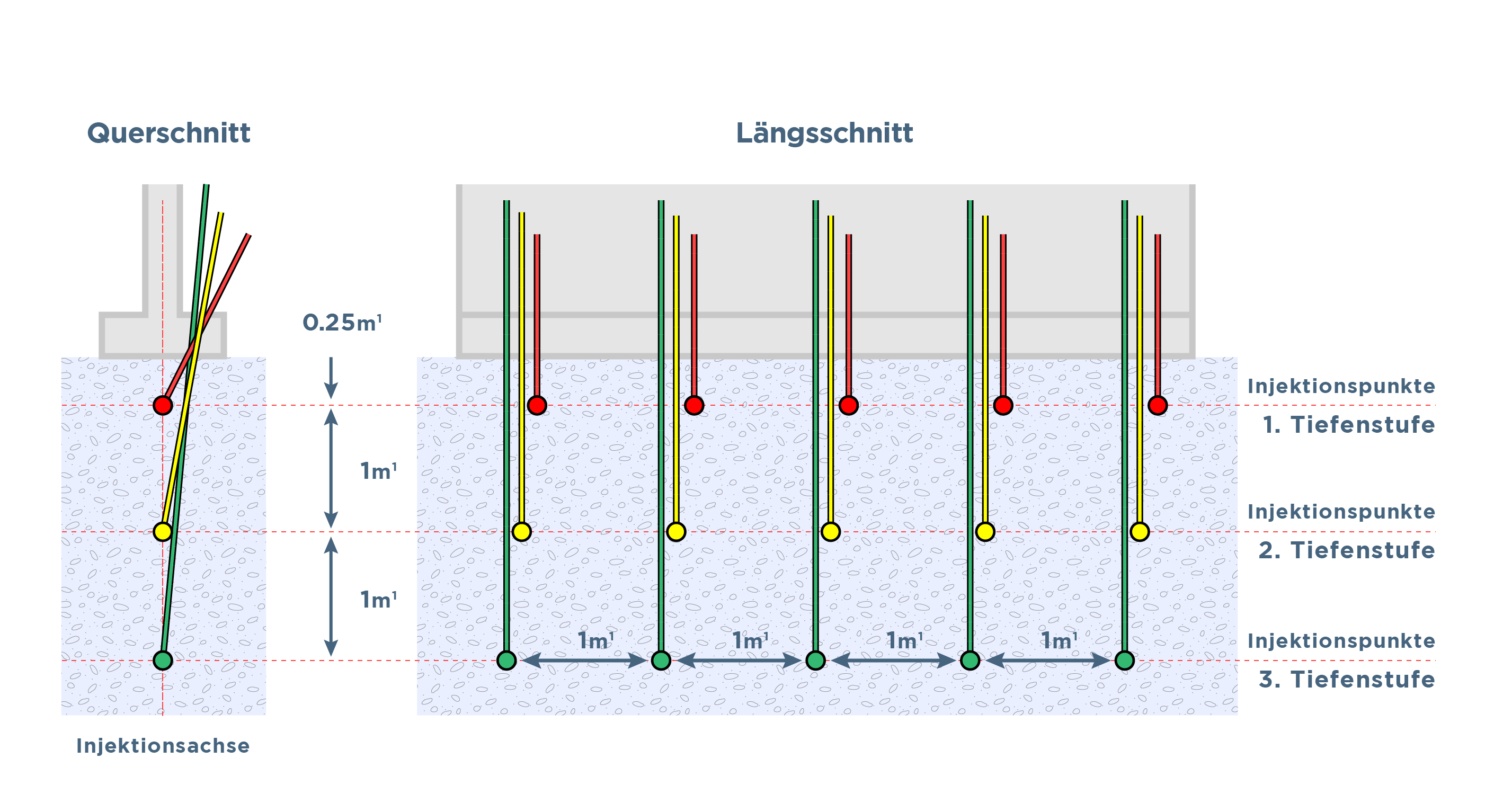
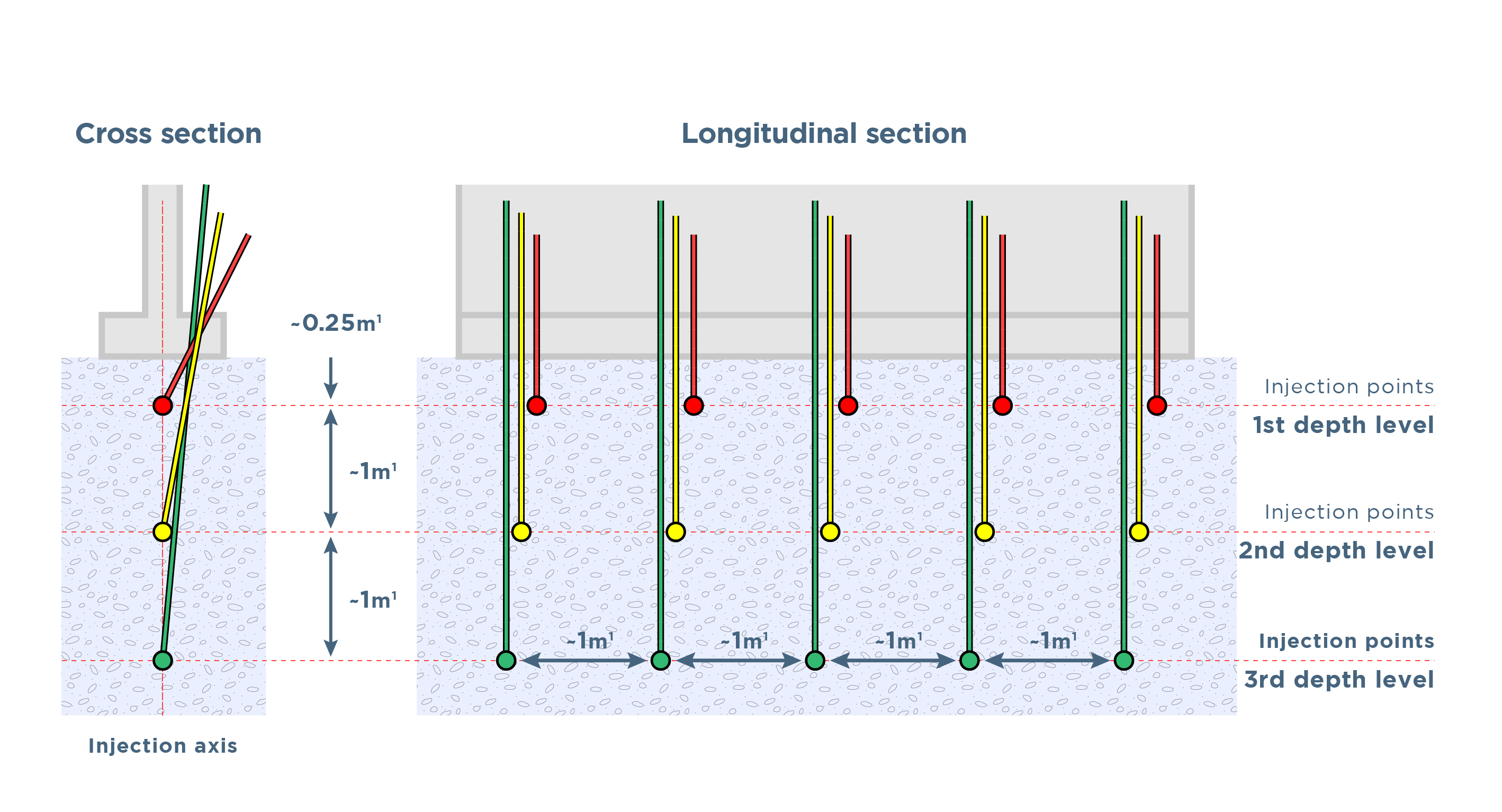
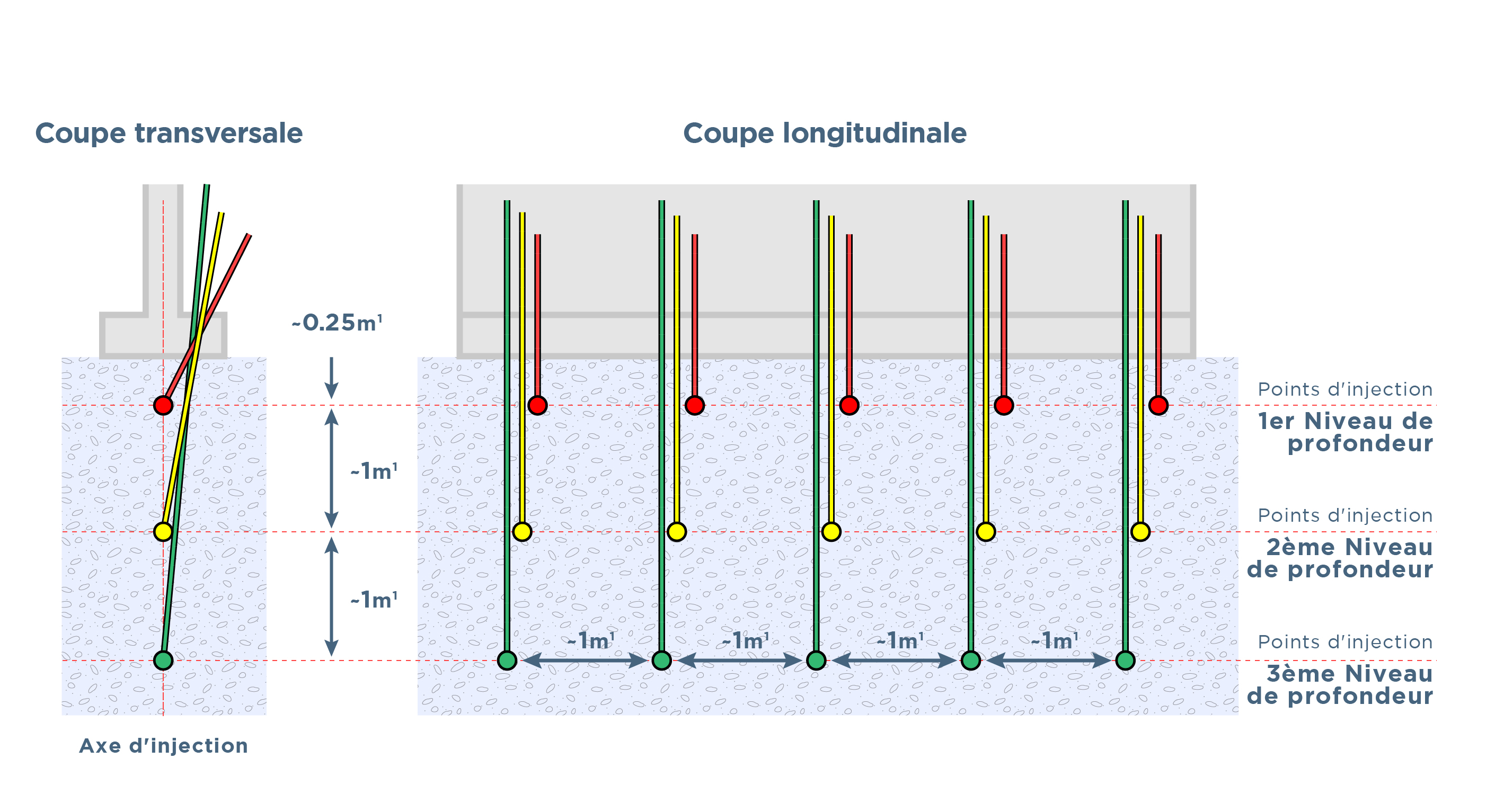
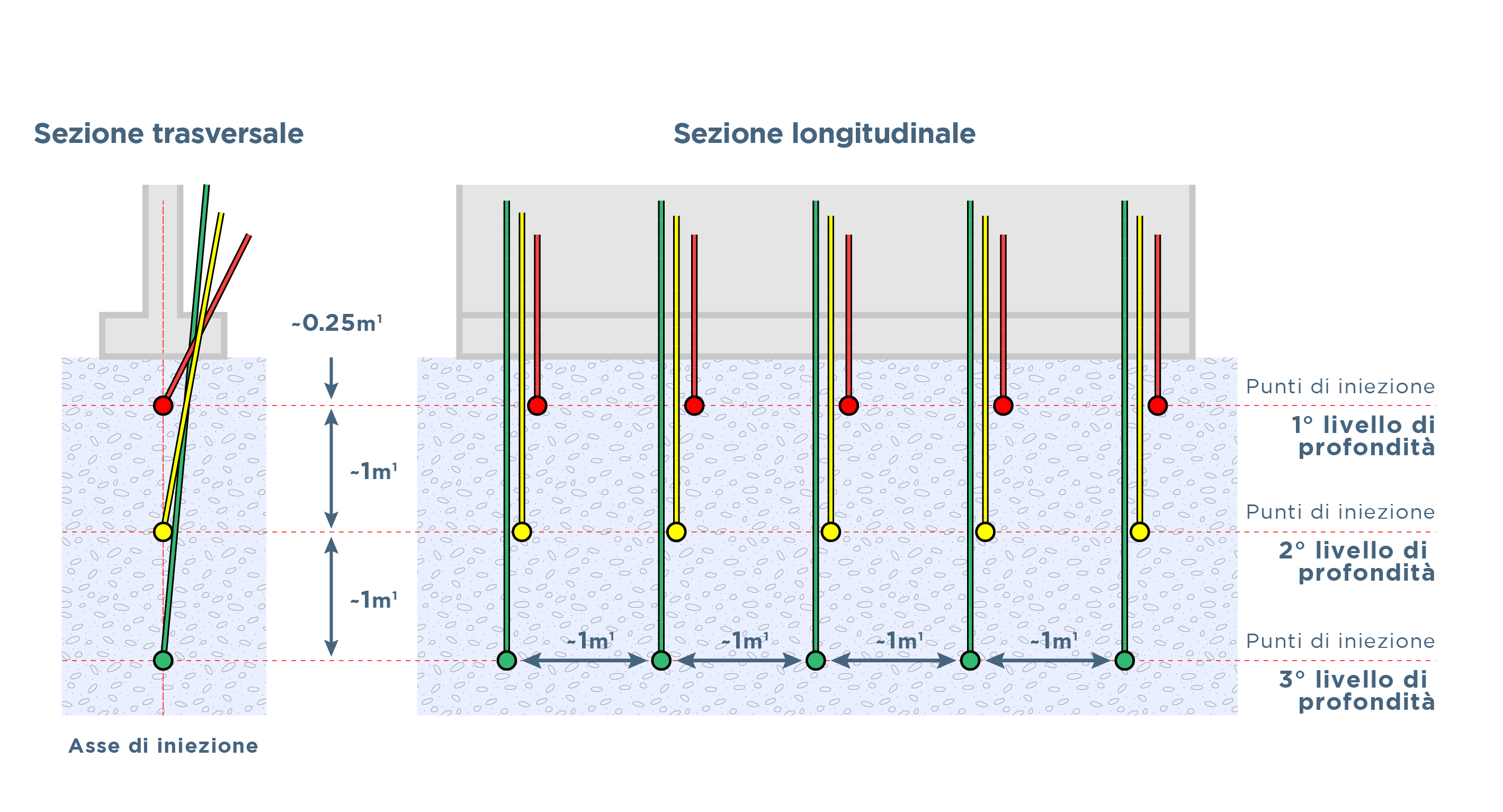
In ground PUR injection, foaming polyurethane is injected into the ground to be treated using injection lances (steel pipes, Ø 12 mm) in a defined grid pattern and at several different depths.

The sketch shows a standard injection concept.

Baugrundinjektion DE3x 100

Baugrundinjektion EN3x 100

Baugrundinjektion FR3x 100

Baugrundinjektion IT3x 100

The injection lances are placed in the ground through pre-drilled holes (Ø 32 mm). Once the injection work is complete, the lances remain capped at ground level in the ground and cannot be re-injected.

The preheated synthetic resin (to 40°C) is pressed into the ground from the injection system at high pressure (up to a maximum of 140 bar). As soon as it leaves the injection pipe, the liquid resin begins to foam within a few seconds. The foaming resin penetrates further into the soil structure through its own expansion force.

Depending on the soil type, the resin penetrates the pore volume of the building ground and/or presses open flow paths. In the process, the fully expanded and hardened resin cements and compacts the building ground, reducing the pore volume and increasing the shear strength, which leads to an improvement in the load-bearing capacity of the building ground.

During the injection work, the structure is continuously monitored with laser levelling instruments. Each lance is precisely logged in terms of the amount of resin injected and the lifting reaction that has occurred.

Get your house back on track

Once the building ground has been sufficiently stabilised, additional injection lances can be used to continue the injection work and raise the structure in a targeted manner.

The continued inflow of injection material leads to an increase in volume in the building ground, which locally pre-stresses the building ground. Ultimately, the prevailing tension in the ground is overridden, resulting in a bulging of the building ground or a lifting of the structure above it. The inflow of injection material is continued until the desired lifting target is achieved. To this end, additional injection lances are continuously and repeatedly placed along the injection axes and used to continue the injections.

During the injection work, the building structure is permanently monitored with laser levelling instruments, and the injection work is recorded lance by lance in terms of the amount of resin injected and the degree of lifting achieved.

Important: Successful building lifting requires that the building be founded on a sufficiently strong concrete floor slab. In addition, potential risks, such as damage to sewage pipes laid under the floor slab, must be taken into account.

The economic limit of building lifting by means of ground PUR injection is an elevation height of approximately 25 cm.

Increase ground bearing capacity

When a building is extended, converted or renovated, the load on the structure often increases, which also increases the ground pressure under the building foundations. Without first increasing the load-bearing capacity of the building ground, there is a risk of settlement.

A PUR injection into the building ground increases its load-bearing capacity to such an extent that the increased load of the structure can be supported without settlement. This is carried out using the same method as for building ground reinforcement to stop settlement.

Seal leak in excavation pit wall

When excavation pits are enclosed with sheet piling, diaphragm walls or pile walls, gaps or unwanted leaks can occur in the excavation pit wall, allowing groundwater to flow into the excavation pit together with soil material. Such incidents can cause considerable damage, which is why the openings must be closed and sealed. As an immediate measure, it can be helpful to leave a berm in place or fill one in front of the opening.

For permanent sealing, PUR injection into the building ground is a proven solution. In the case of known gaps, the injection can be carried out before the excavation work in order to seal the opening. Rapidly foaming polyurethane is injected into the building ground via injection lances (Ø 12 mm) in an adapted grid, often step by step from top to bottom, parallel to the removal of the berm or the excavation.

Depending on the soil type, the resin penetrates the pore volume of the subsoil or presses flow paths. The expanded and hardened resin compacts the subsoil, reduces the pore volume, increases the shear strength and reduces water permeability.

This method is also suitable for the construction of impermeable walls and floors. In existing buildings, for example, pits for new lift shafts below the groundwater level can be excavated and concreted without a special excavation wall and with only open dewatering.

Sealing Arteser during geothermal
drilling

When sinking a geothermal borehole, there is a risk of breaking through dense soil layers under which groundwater is present at a pressure level above the ground surface. In this case, the water rises in the borehole to above the ground surface and flows out of the borehole (known as an artesian well).

If all other methods of sealing artesian wells have been tried without success, the flow of water in the borehole can be stopped by injecting fast-foaming polyurethane, thereby successfully sealing the artesian well.

SoilTec AG proceeds as follows:

The PUR injection foam is injected into the ground around the geothermal probe borehole at three different depths using injection lances (Ø 12 mm). To insert the injection lances, the ground is pre-drilled to the maximum achievable depth of approximately 10 m using a pile driver (Ø 32 mm) and a hydraulic pile hammer (30 kg). Immediately after the pile driver is withdrawn, the injection lances of varying lengths are inserted into the pre-drilled hole as a bundle.

During injection, the initially liquid polyurethane, preheated to 40°C, is pressed into the pore space of the soil using an injection pump (maximum 140 bar). After about 10 seconds, the resin begins to foam, pressing further into the soil structure and also into the annular space of the geothermal probe, stopping the flow of water in the borehole. The polyurethane foaming in the annular space penetrates deep into the borehole due to the expansion pressure, so that the seal is also effective at greater depths of the borehole. The treated soil forms a three-stage sealing collar around the ground probe in the injection area, which prevents water from flowing around the seal and permanently stops the flow of water rising from the depths.

We stabilize your house. Soil stabilization through injection of synthetic resin is the most economical and fastest solution for restoring the stability of a house. We specialize in soil stabilization through PUR injections and are happy to support you with our professional services.

SoilTec AG
Postfach 453
4800 Zofingen
T. 0800 400 111

Icon 1 Icon 1 Hover Icon 2 Icon 2 Hover Icon 3 Icon 3 Hover Icon 4 Icon 4 Hover Icon 6 Icon 6 Hover Icon 6 Icon 6 Hover
Rufen Sie an
0800 400 111